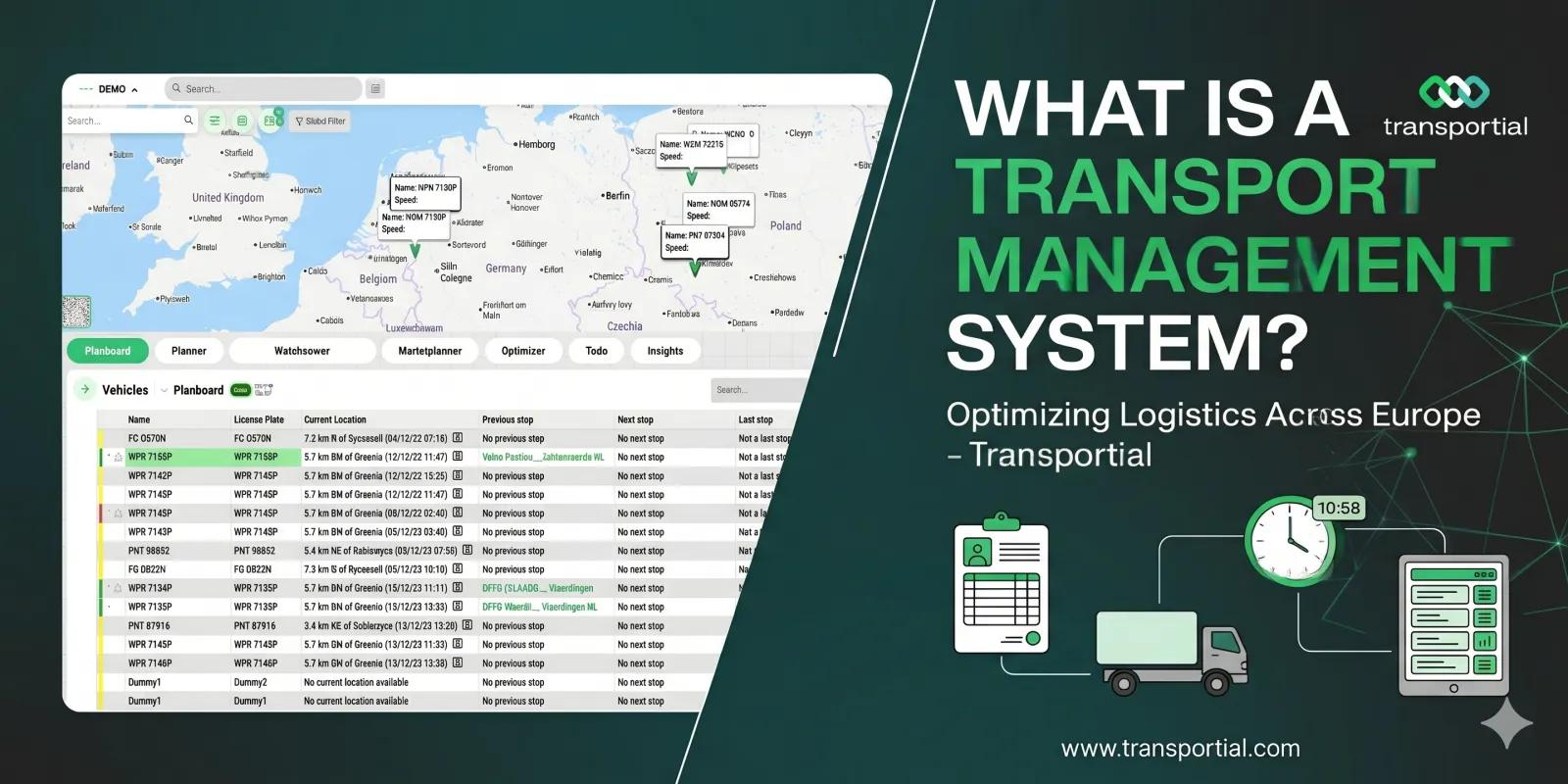
A Transport Management System (TMS) is the software platform a logistics company uses to plan, execute, and account for the movement of freight. It is to a transport operator what an ERP is to a manufacturer: the operational system of record. Everything that touches a shipment — from the customer's booking, through the planner's allocation of vehicles and drivers, the driver's proof of delivery, and the eventual invoice to the customer — flows through it.
This guide explains what a TMS does, who needs one, how it differs from adjacent systems like ERPs and WMSs, what implementations typically cost, and how to evaluate a TMS for your operation. It is written for transport companies, freight forwarders, 3PLs, shippers managing their own fleet, and the IT teams that procure software on their behalf.
What does a TMS do?
A modern TMS covers four operational stages:
- Order capture and quoting. Booking a transport order — manually, by EDI, by API from a customer portal, or extracted by AI from a PDF or email — then quoting it against rates, contracts, and capacity.
- Planning and execution. Allocating consignments to trips, trips to vehicles, vehicles to drivers, with consideration of EU driver-hours regulation (561/2006), tachograph rest windows, vehicle restrictions (ADR, height, weight), customer service-level agreements, and route optimisation across multi-stop trips.
- Real-time visibility. GPS or telematics-fed truck positions, ETAs against committed time windows, electronic proof of delivery, in-app driver communication, and customer-facing tracking links.
- Settlement. Self-billing or vendor-billing carriers, invoicing shippers, capturing CMR documents and weighbridge tickets, reconciling fuel, tolls, demurrage, and surcharges, and pushing the financial record into accounting.
On top of those four stages most TMS platforms layer reporting (CO₂ and CSRD emissions, on-time performance, cost-per-kilometre, vehicle utilisation), document management (CMR, packing list, dangerous-goods declarations), and integrations (telematics, navigation, customs platforms, marketplaces, accounting).
Who needs a TMS?
Roughly speaking, any operator handling more than a handful of trucks or more than a few hundred consignments per month benefits from a TMS. Spreadsheets and WhatsApp groups work up to a point; beyond it, the cost of missed pickups, double-booked drivers, and unbilled extras outweighs the cost of the software many times over.
Five specific profiles see the largest return:
- Hauliers and transport companies running their own fleet across long-haul, regional, or last-mile work. A TMS replaces the planning whiteboard, automates customer ETAs, and turns proof of delivery into instant invoicing. See haulage software for transport companies.
- Freight forwarders orchestrating road, sea, air, and rail across borders. The forwarder rarely owns the assets — the TMS becomes a marketplace, dispatching to carriers, tracking subcontractors, and reconciling vendor invoices automatically.
- 3PLs / logistics service providers serving multiple shippers under SLAs. The TMS is the shared operational backbone across contracts and warehouses, with per-customer rate cards and KPI dashboards.
- Shippers with private fleets — supermarket chains, food distributors, parcel networks. The TMS replaces home-grown planning tools and connects truck movements to the broader supply chain.
- Couriers and last-mile operators doing high-volume, low-weight delivery. Specialised dispatch and route-optimisation features inside the TMS keep cost-per-stop competitive with the big networks.
How does a modern TMS work?
Architecturally, a contemporary TMS is a cloud-native, multi-tenant SaaS platform with a web planner application, a native driver app, a REST or GraphQL API, and a queue of event-driven workflows. The data model centres on three first-class entities:
- Consignment — a single shipment with goods, origin, destination, time windows, and references.
- Trip — a sequence of actions a single resource (vehicle, driver, trailer) executes, often containing multiple consignments.
- Action — the atomic operation: pick up consignment X at location A within window W₁, deliver to location B within window W₂.
Open data standards matter here. OTM5 (Open Trip Model) and OTM2 are the European standards for sharing transport orders, trips, and events between carriers, shippers, and brokers without bespoke EDI mappings. A TMS that speaks OTM5 natively integrates with carriers, marketplaces, and shippers in days rather than months.
Around the core data model sit the integrations: telematics providers for live truck positions, navigation systems (Webfleet, Mapon, Transics, PTV), customs and toll platforms, accounting software (Exact, Twinfield, SAP, Microsoft Dynamics), and the AI document layer that extracts transport orders out of PDFs and inbound emails.
How much does a TMS cost?
TMS pricing varies enormously and roughly tracks the deployment model.
- Legacy on-prem TMS (SAP TM, Oracle TM, Manhattan): licence fees in the low-to-mid six figures EUR per year, with implementation costs of €250k–€2M+ for a 6–18 month rollout. Justifiable only for very large shippers or carriers with bespoke needs.
- Cloud-native, seat-based SaaS TMS (CargoWise, Alpega, Descartes): typically €40–€150 per user per month, plus per-shipment fees, with a 3–6 month onboarding.
- Transactional / usage-based TMS (Transportial, Qargo, modern entrants): from €0.50 per transaction at the low end down to €0.01 at scale, with no per-user license. Transportial's Starter plan covers 20 consignments, 10 trips, and 3 internal users per month for free.
Beyond the licence fee, budget for telematics hardware (€200–€500 per vehicle if not already deployed), driver-app device costs (a phone or rugged tablet per cab), integration work for adjacent systems, and ongoing training. The total cost of ownership for a 50-vehicle operation typically lands somewhere between €30k and €150k per year, with the transactional model favouring smaller, faster-growing operators.
TMS vs ERP vs WMS — what's the difference?
The three systems sit next to each other and often integrate, but they own different processes.
- TMS owns transport: the planning, execution, and settlement of freight movement. It is the system of record for trips, vehicles, drivers, and consignments.
- WMS (Warehouse Management System) owns the inside of the four walls: receiving, putaway, picking, packing, inventory. It hands off to the TMS at the loading dock.
- ERP owns the financial and HR backbone: general ledger, payables, receivables, payroll, fixed assets. The TMS posts invoices and payables into it; the ERP rarely understands what a trip is.
For a pure transport operator the TMS is the operational core and the ERP is a peripheral. For a manufacturer with a private fleet the ERP is the core and the TMS is a peripheral. Pick your gravity centre accordingly — the wrong choice forces awkward two-way reconciliation that nobody enjoys.
What to look for in a TMS in 2026
The market has consolidated around a handful of must-haves. If a vendor cannot demonstrate these on a demo call, walk.
- A native driver app, not a browser link. Drivers do not work on laptops. Step-by-step actions, offline support, ePOD, in-app chat — table stakes.
- Open standards by default. OTM5 in and out, REST API documented with OpenAPI, webhooks for every business event. If you have to pay for an integration to your own telematics, the architecture is wrong.
- EU regulation built-in. 561/2006 driver hours, ADR for dangerous goods, ATP for refrigerated cargo, CSRD/ESRS for emissions reporting, and the electronic consignment note (e-CMR, under the 2008 Additional Protocol to the CMR Convention) with a path to eFTI: Regulation (EU) 2020/1056 obliges authorities to accept electronic freight information from certified eFTI platforms from 9 July 2027. Bolt-on modules age badly.
- Real GPS and ETA accuracy. Live truck position broadcast at <60-second intervals, ETA against committed windows, and the ability to share a customer-facing tracking link without inventing a separate product.
- Transactional pricing or transparent flat fees. Per-user licensing with multi-year contracts punishes operators with seasonal headcount swings and rewards the vendor for shelf-ware. A clear unit price per shipment, trip, or invoice maps cleanly to your P&L.
- AI for the dull stuff. Extracting transport orders out of customer emails and PDFs. Suggesting trip allocations. Flagging exceptions. The bar is no longer novelty — it is whether the platform removes work or adds it.
- Reference customers in your segment. A TMS that runs a parcel network does not automatically run a tank-haul operation. Ask for case studies that look like you.
Next steps
If you are evaluating a TMS, start by mapping the four stages above against your current operation. Where is the manual work? Where do errors cluster? Where do customer complaints come from? A 60-minute internal audit usually identifies €5–€50 per consignment of recoverable margin — and that becomes the budget envelope for a new platform.
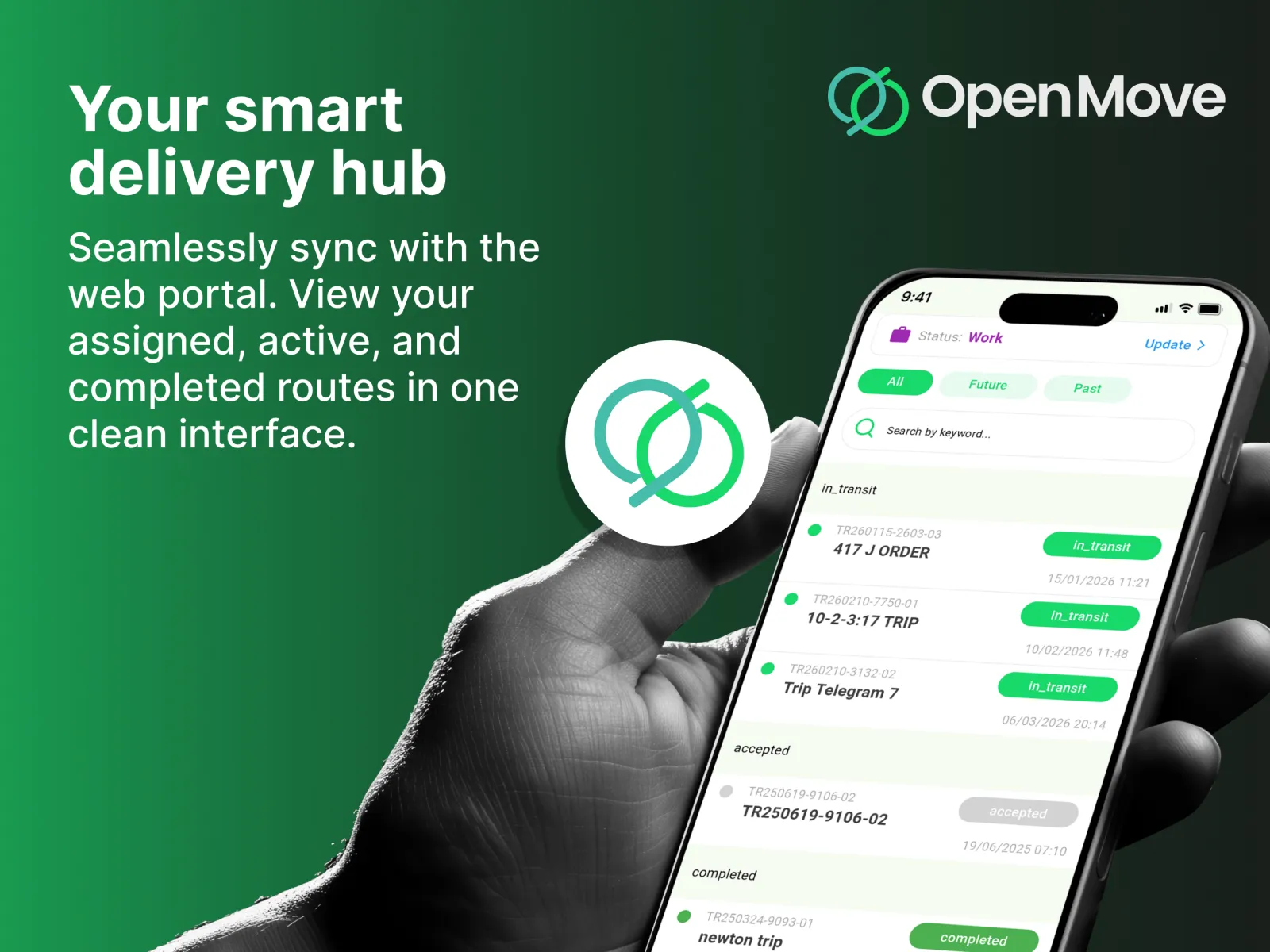
Transportial is an operational TMS built around those principles. It is OTM5-native, transactional in pricing, ships with the OpenMove driver app, issues eCMRs natively, and connects to Webfleet, Mapon, PTV, Transics, Exact, and dozens of others out of the box. If you would like to see it against your own operation, book a 30-minute demo or read more on the product overview page.
Frequently asked questions
- What does TMS stand for in logistics?
- TMS stands for Transport Management System. It is the software platform a logistics company uses to plan, execute, and account for the movement of freight — covering order capture, planning, real-time visibility, and settlement.
- What is the difference between a TMS and an ERP?
- A TMS owns the operational transport workflow — trips, vehicles, drivers, consignments, ETAs, and freight invoicing. An ERP owns the financial backbone — general ledger, payables, receivables, payroll. A TMS typically posts invoices and cost lines into the ERP, but the ERP rarely understands what a trip is.
- How much does a TMS cost per month?
- Pricing ranges from free Starter tiers on transactional platforms (e.g. Transportial Starter covers 20 consignments, 10 trips, and 3 users per month at no cost) up to €5,000–€20,000+ per month for legacy enterprise TMS deployments with per-user licensing and implementation fees. Cloud-native transactional pricing typically lands at €0.50 down to €0.01 per shipment depending on volume.
- Who needs a TMS?
- Any transport operator running more than a handful of trucks or processing more than a few hundred consignments per month benefits from a TMS. The five highest-ROI profiles are hauliers, freight forwarders, 3PLs, shippers with private fleets, and last-mile couriers.
- What is OTM5 and why does it matter for a TMS?
- OTM5 (Open Trip Model version 5) is the European open standard for sharing transport orders, trips, and events between carriers, shippers, brokers, and platforms. A TMS that speaks OTM5 natively can integrate with marketplaces, telematics, and customer systems in days rather than the months required for bespoke EDI mappings.
- Can a TMS replace my spreadsheet planning?
- Yes — replacing a planning spreadsheet is the most common starting point for a TMS implementation. A modern TMS visualises every vehicle, driver, trailer, and trip on a unified timeline, supports drag-and-drop allocation, validates EU driver-hours regulation, and propagates plan changes to the driver app instantly. Most operators see ROI within 60–90 days of cutover.
- What is the difference between a TMS and a WMS?
- A WMS (Warehouse Management System) manages inventory inside the warehouse — receiving, putaway, picking, packing. A TMS manages transport between locations. The handover happens at the loading dock: the WMS releases an outbound shipment, the TMS picks it up and runs the road leg. Most operators run both, integrated.
- How long does it take to implement a TMS?
- Implementation time varies sharply by deployment model. Legacy on-prem TMS deployments (SAP TM, Oracle TM) take 6–18 months. Cloud-native seat-based platforms run 3–6 months. Transactional SaaS TMS platforms with OTM5-native integrations can be live in 2–6 weeks for a small-to-mid-size operator, with telematics and accounting integrations following in the next 30–60 days.
- Is a TMS worth it for a small transport company?
- Yes, provided the pricing fits. A small operator gains the most from removing spreadsheet planning, automating customer updates, and producing clean invoices and freight documents. Transactional or free-tier pricing makes a modern TMS accessible without a large upfront commitment, so even a handful of vehicles can benefit.