

A planning engine for the system you already have
Send consignments, vehicles and drivers, and get trips back. By API from your own TMS, or on screen in a workspace that has only the planner.






















Your system stores the plan, but it does not make it
Planning by hand stops scaling
A planner can combine thirty consignments in their head. At three hundred, the best plan is never found.
The rules live in people
Driving times, time windows, opening hours, dangerous goods and trailer types are checked from memory.
A second tool means double work
A separate route planner needs its own copy of your orders and fleet, and its result is typed back by hand.
Behind your own planning screen
What you send
- Consignments with time windows
- Vehicles, trailers and drivers
- Carrier contracts with their prices
- Your own distance matrix, if you have one
Route Optimisation
- Assigns consignments to assets
- Puts the stops in order
- Checks driving time, capacity and the load
- Prices each trip
What you get back
- Trips with stops and times
- A load plan per vehicle
- The cost per trip
- The consignments that did not fit
From a list of consignments to a plan you can drive
- One API call or one screen
Send the work
One call carries consignments, vehicles, trailers and containers, drivers and carrier contracts, with requirements, opening hours and driving rules. Or enter stops and a vehicle in the route planner on screen.
- Preview before you commit
Get trips back
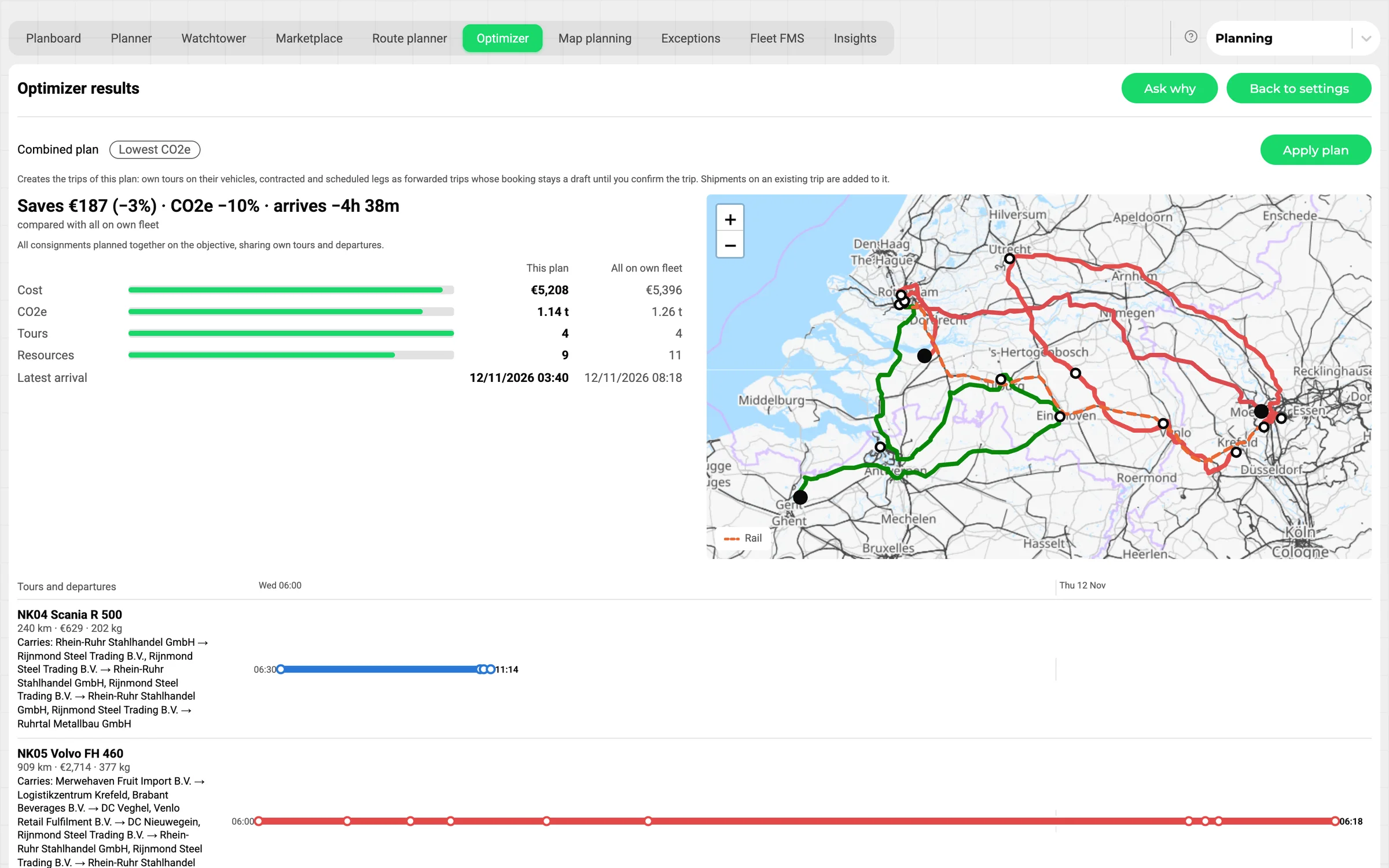
The solver decides which vehicle, driver, trailer or carrier takes each consignment and in which order the stops are served. Road, rail, barge and ferry legs can be part of one plan. On screen you see the proposal before anything is changed.
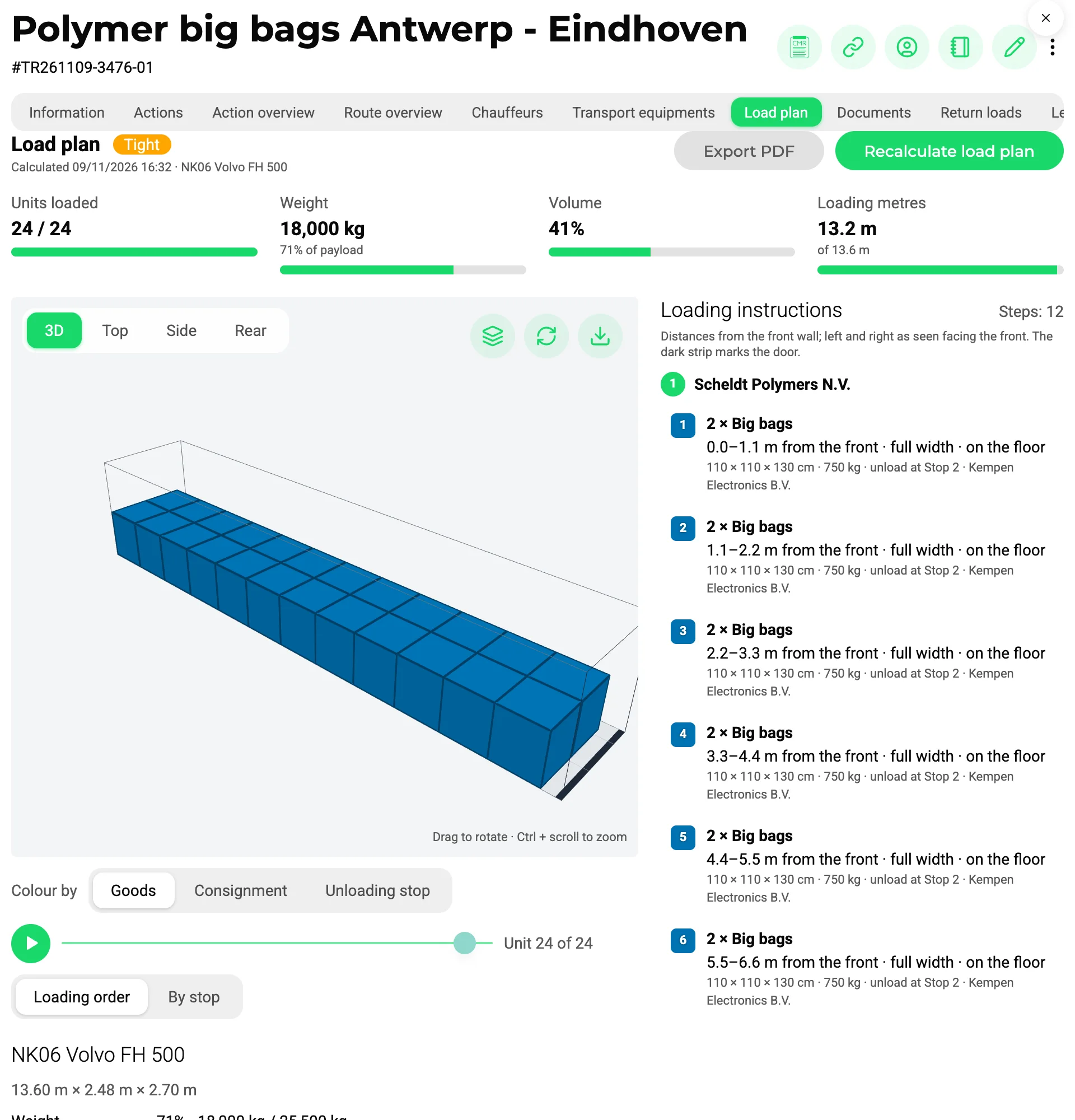
- A 3D load plan per vehicle
See how it is loaded
A 3D load plan shows where each pallet, crate or drum stands in the trailer, within the stacking rules and the weight the vehicle may carry.
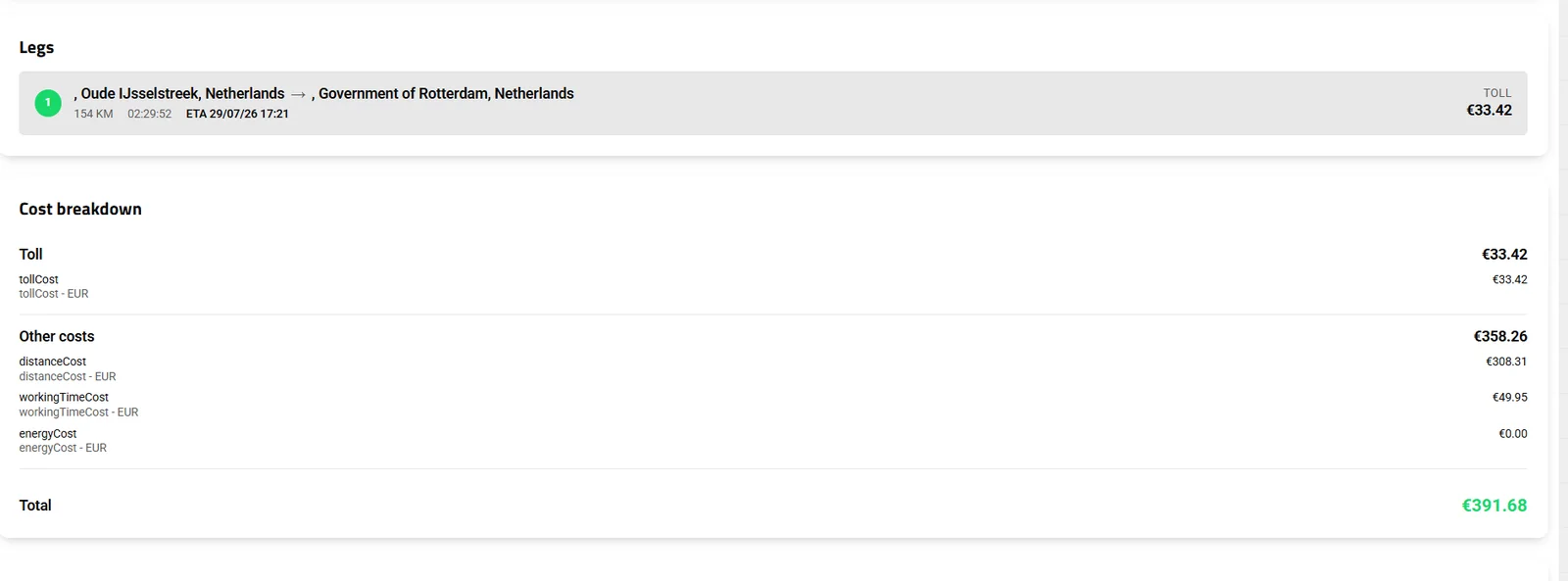
- Distance, toll and cost per trip
Know what it costs
Each route comes with distance, time, toll and cost. Carrier contracts are priced with their own pricing rules, so own trucks and carriers are compared on the same basis.
- 1
- API call from consignments to trips
- 4
- asset types: vehicles, trailers, drivers and carrier contracts
- 3D
- load plan per vehicle
- 0
- orders stored when you plan through the API
Routing engines you can connect
Pay per calculation through the API, per trip on screen
No licence fee and no minimum. The platform list is on the pricing page.
Through the API
Each successful calculation is counted, and a number of them is free every month. Ask us for the price per calculation at your volume.
On screen
The first 10 trips of every month are free, with no end date. Above that from €0.50 per trip, and cheaper as your volume grows.
When you want more than the engine
Plan on the board
Drag consignments onto vehicles and drivers on a timeline, with conflicts shown as you plan.
Send the trip to the driver
The OpenMove app guides the driver stop by stop and sends back positions and proof of delivery.
Price and invoice the work
Pricing rules calculate each order, and the invoice follows from the finished trip.
Route optimisation: frequently asked questions
Can I call it from my own TMS?
Yes. The solver and the load planner are separate API calls that take all their input in the request and keep nothing afterwards. The developer hub describes both, with examples.
Which rules does a plan respect?
Capacity in weight, volume, loading metres and pallet places, time windows and opening hours, driving and rest times, vehicle and driver requirements such as dangerous goods or a tail lift, and the stacking rules of the load.
Do I need a routing provider?
No. You can send your own distance matrix or let Transportial estimate distances. On screen, the workspace uses the routing engine you choose, with truck restrictions and toll.
Can it plan carriers as well as my own trucks?
Yes. A carrier contract is planned like an asset, with its own lanes, capacity and prices, so the plan shows which work to give away and which to drive yourself.
Is it only for road?
No. A consignment can travel by road to a terminal, by rail, barge or ferry between terminals, and by road again, in one plan.